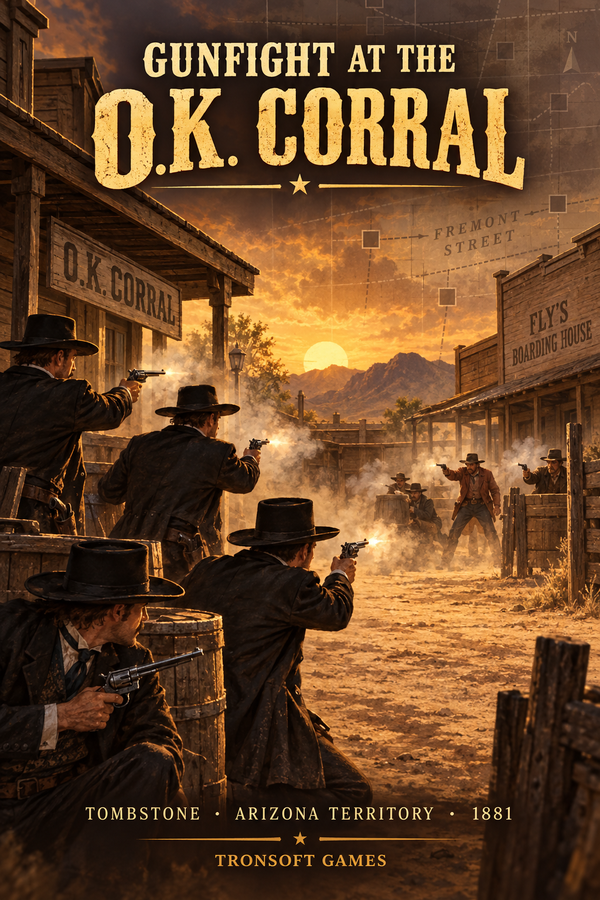
v0Tombstone, Arizona Territory — Wednesday, October 26, 1881, about 3 p.m.
Round ———Point at the map
Gunfight at the O.K. Corral
Fremont Street, Tombstone — October 26, 1881. Thirty seconds, some thirty shots. And after it, the vendetta.
Small-unit tactics in the Old West: a handful of men, a few yards of dirt, a freight wagon and some nervous horses. New to it? Start with the Tactics Primer. Every shot is a slip of odds you can read before you pull the trigger. Cover, smoke, movement and nerve decide it as much as marksmanship.
The Scenario
Lessons are always played as the lawmen, against the computer at Gunhand.
Your Side
The Opposition
The Disputed Point
How to Play
Each round every man still in the fight acts once, in an order set by his quickness and luck. The active man is ringed in gold. He has two actions (one if shaken or down).
The Tactics Primer — five short lessons, each with an objective shown on the left: reading the odds, moving from cover to cover, fire and movement, the flank, and breaking an enemy's nerve.
The view — drag to pan, wheel or pinch to zoom; arrow keys pan, + − 0 zoom and fit, C centres on the active man.
Move — click a lit square. Diagonal steps cost more; a man lying flat or down crawls only a square.
Shoot — click an enemy. The Odds Slip on the left shows every factor first: range, cover near the target, smoke, men in the line of fire, movement, wounds, aim.
Take aim — +15 on the next shot, lost if you move.
Fan the hammer — both actions, up to three quick shots at −25 each. Standing still only.
Reload — two cartridges a revolver, two shells the coach gun, three the rifle.
Pull saddle rifle — beside a horse that still carries its Winchester. Horses shy at gunfire and may bolt, rifle and all.
“Throw up your hands!” — Virgil Earp, as marshal, may call on every cowboy who can see him to surrender. Unarmed and shaken men comply more often. A man with his hands up is out of the fight — shooting him counts on the record.
Leave the fight — from a doorway or the edge of the map.
Hold fire, covering — spend what is left of his turn watching. Until his next turn he takes a snap shot (−5) at the first enemy who fires in his sight, or, once the fight has begun, who moves in it. A man who moves across open ground under covering guns is shot at before he gets there.
Saving a position. The fight still autosaves after every action. Snapshot (S) stores one separate tactical position so you can try a plan and return to it later; Restore (K) returns to that exact position, including the random-number state. A new snapshot replaces the previous one.
Learning the ground. Click a man in the roster or initiative strip to centre and inspect him. The map HUD reports distance from the active man and, when relevant, current shot odds or whether a square is reachable. Point at any empty square to see which enemy guns could hit a man standing there, and at what odds. If the square is reachable and you would still have an action after moving, the map also previews your best firing lanes from that position. Threat map (T) tints every square by the guns that bear on it. Odds overlay (X) places the current hit chance above every enemy you can shoot. Fire lanes (I) draws the active man’s legal shots directly across the map, with line style and labels showing shot quality. Best target (Q) cycles through visible enemies from the strongest current shot downward. Range guide (B) shades squares outside the active weapon’s maximum range and marks the range boundary. Minimap (M) shows both sides and your current viewport; click it to jump around the battlefield. Advise me (V) marks the order the computer would give in your place and says why. Undo the move (U) takes back a move, so long as no dice were rolled because of it.
Ground. Walls and doorways block sight; barrels, troughs, wagons, trees and rocks give cover when they lie close to the target and between him and the shooter. Brush does not stop a bullet but hides a man in it (−10). Water cannot be crossed.
Nerve. A man who is shot at, wounded, or sees a friend fall tests his nerve when he next acts. He may be shaken (one action, −15 to hit) or, if not a hard man, panic and run for the nearest exit. A leader nearby (Virgil, Frank McLaury) steadies men.
Wounds. One wound slows a man's shooting. Two put him down — he can still fire from the ground, as Billy Clanton did. Three kill him.
The end. It ends when one side has no one left able to fight, or when Sheriff Behan and the townsmen close in at the round limit. Points count men killed, down, wounded, surrendered and fled. The verdict compares your margin with par, the margin measured over hundreds of computer-played fights in that scenario — so a lawman who merely wins the historical fight has done only what history did. Par is measured separately for each difficulty and each side. The fight saves itself as you play; Resume appears on the title card. After the fight, Watch the replay steps through every move and shot.
Keyboard play: Shift+arrows move a cursor over the map, Q jumps it to the next enemy in sight, Enter moves to or fires at the cursor square, Esc clears it. Tab reaches every button. Keys: V advise · A aim · F fan · O cover · U undo · T threat map · X odds · I fire lanes · B range · Q target · M minimap · S snapshot · K restore snapshot · R reload · W weapon · P flat/stand · G rifle · H hands · L leave · Space end turn · N new game · arrows pan · + − 0 zoom · C centre · ? help.